Loading...
Searching...
No Matches
Grid< T > Class Template Reference
#include <Grid.h>
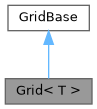
Inheritance diagram for Grid< T >:
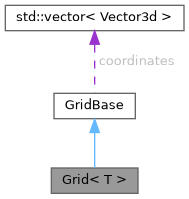
Collaboration diagram for Grid< T >:
Public Member Functions | |
| Grid (int) | |
| Grid (Vector3d, Vector3d, int ngridx, int ngridy=1, int ngridz=1) | |
| Create a Cartesian uniform grid between two endpoints. | |
| Grid (Vector3d, Matrix3d, Vector3d, Vector3d, int ngridx, int ngridy=1, int ngridz=1) | |
| Create a cell-aligned uniform grid, including non-orthogonal cells. | |
| Grid (std::string) | |
| virtual | ~Grid () |
| void | read (std::string) |
| void | write (std::string) const |
| void | setCounter () |
| std::vector< std::set< int > > | getGridNeighborLists (const SubConfiguration &, const double &) const |
Public Attributes | |
| int | ngrid |
 Public Attributes inherited from GridBase Public Attributes inherited from GridBase | |
| std::vector< Vector3d > | coordinates |
Additional Inherited Members | |
| Static Public Attributes inherited from GridBase | |
| static int | numberOfReferenceGrids = 0 |
| static int | numberOfCurrentGrids = 0 |
Detailed Description
template<ConfigType T>
class Grid< T >
class Grid< T >
Describes a grid on which stress is computed.
A grid may be read directly from a coordinate file, generated by Cartesian lower/upper endpoints, or generated in the basis of a supplied cell. The cell-aligned constructor interprets upperLimit-lowerLimit in the cell-vector basis, so it can create a uniform grid aligned with a non-orthogonal simulation box. Grid points are not folded into the primary periodic cell.
- Template Parameters
-
T - StressType (Cauchy/Piola)
- Examples
- crack/main.cpp, testGrid.cpp, testIdealGas.cpp, testLDADLJ.cpp, testLDADSWTriclinic.cpp, testLJ.cpp, and testMls.cpp.
Constructor & Destructor Documentation
◆ Grid() [1/4]
template<ConfigType T>
| Grid< T >::Grid | ( | int | _ngrid | ) |
◆ Grid() [2/4]
template<ConfigType T>
| Grid< T >::Grid | ( | Vector3d | lowerLimit, |
| Vector3d | upperLimit, | ||
| int | ngridx, | ||
| int | ngridy = 1, |
||
| int | ngridz = 1 |
||
| ) |
◆ Grid() [3/4]
◆ Grid() [4/4]
template<ConfigType T>
| Grid< T >::Grid | ( | std::string | filename | ) |
◆ ~Grid()
template<ConfigType T>
|
virtual |
Member Function Documentation
◆ getGridNeighborLists()
template<ConfigType T>
| std::vector< std::set< int > > Grid< T >::getGridNeighborLists | ( | const SubConfiguration & | subconfig, |
| const double & | padding | ||
| ) | const |
◆ read()
template<ConfigType T>
| void Grid< T >::read | ( | std::string | filename | ) |
- Examples
- crack/main.cpp, testGrid.cpp, testLDADLJ.cpp, and testMls.cpp.
◆ setCounter()
template<ConfigType T>
| void Grid< T >::setCounter | ( | ) |
◆ write()
template<ConfigType T>
| void Grid< T >::write | ( | std::string | filename | ) | const |
- Examples
- testGrid.cpp.
Member Data Documentation
◆ ngrid
template<ConfigType T>
| int Grid< T >::ngrid |
The documentation for this class was generated from the following files: